FIRST Tech Challenge · Team 2845 · 2023–24
Localization and Navigation
Two-wheel odometry with an IMU is accurate until the robot drives and turns at once. A third wheel fixes that and drifts instead. I used both, with the IMU as a slow correction on the wheels, then wrote the PID navigator that drives to a field coordinate.
2023–2024 · Tampa, FL
Java · Odometry · Sensor Fusion · PID Control
The Problem
Before I worked on it, the robot tracked its position with two odometry wheels and got its heading from the IMU. That is accurate on simple moves, but the IMU updates slowly, so heading lags when the robot drives and turns at the same time, and every position after that is wrong. The usual alternative, a third odometry wheel instead of the IMU, handles those moves well but slowly drifts over a match. Each setup fails where the other one is good.
What I Built
So I used both. A third wheel measures heading moment to moment:
Δθ = (Δright − Δleft) / trackwidth
Δx = (Δleft + Δright) / 2
Δy = Δback − backDist · Δθ
trackwidth is the distance between the left and right wheels, and backDist is how far the back wheel sits from the center of rotation. The last term subtracts the back wheel motion caused by turning, so only real sideways motion is left. Each loop, these changes are rotated by the current heading and added to the field position.
The IMU then fixes the drift. Every 1.2 seconds, heading is reset to the IMU’s value, but only if the two agree within 5°. Slow drift gets corrected, and a bad IMU reading, which would be far off, is ignored. If one of the wheels stops reporting, the robot falls back to two wheels and the IMU instead of losing track entirely.
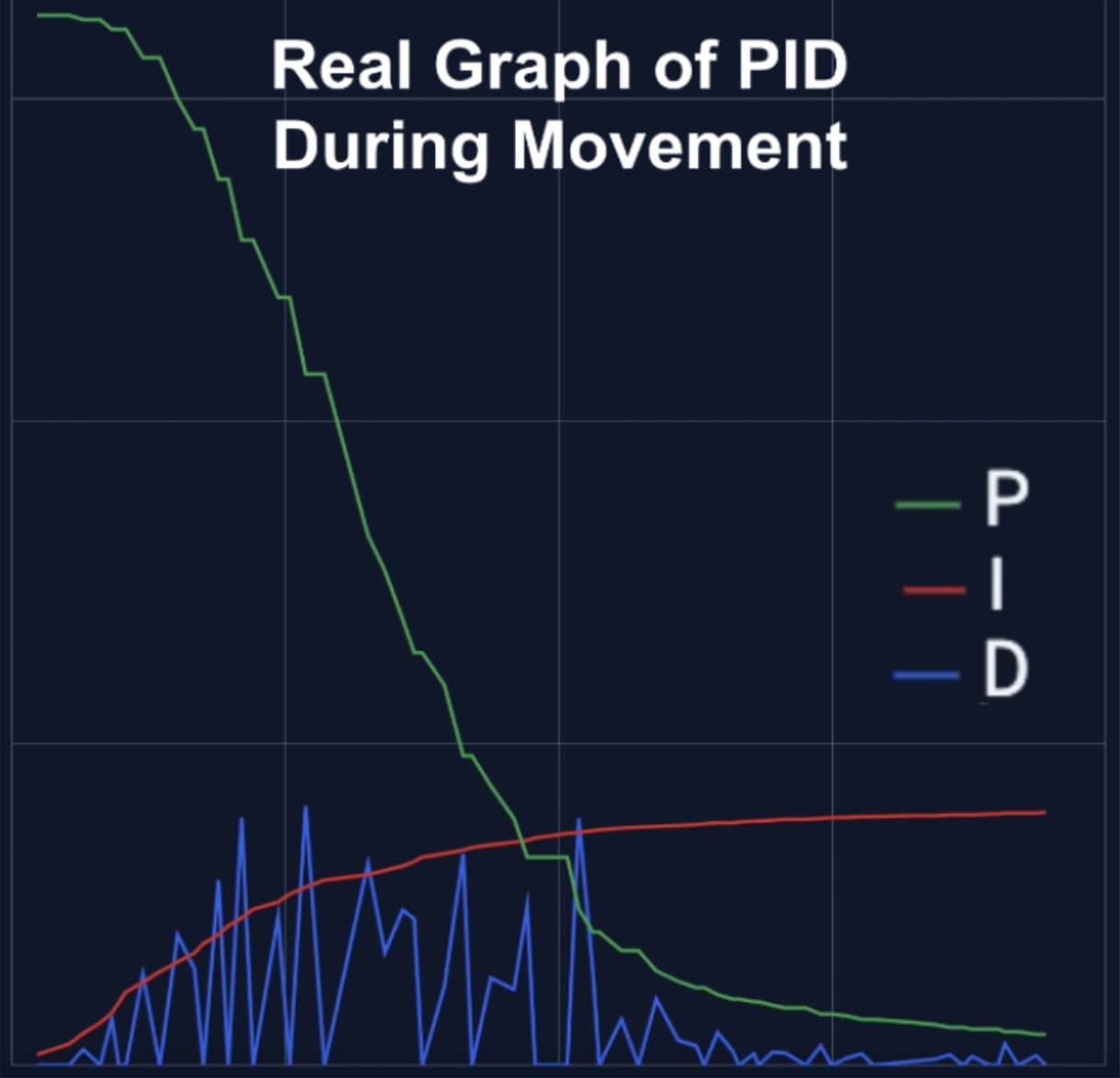
An accurate position is only useful if the robot can drive to one. I wrote a point-to-point PID controller that runs one loop on straight-line distance and another on heading, then rotates the output into the robot’s frame and mixes it into four mecanum wheel powers, so the robot can drive diagonally while it turns. P pushes harder the farther away the robot is. D takes power away as it closes in quickly, so it doesn’t overshoot. I grows the longer the robot sits short of the target, so it doesn’t stall just before it. The heading integral only runs within 6° of the target and resets when the robot swings past, so it can’t wind up during a long turn.
Result
The robot kept an accurate position through fast, combined moves without error building up over the match, and autonomous paths became a list of field coordinates. In 2025–26 we moved to a goBILDA Pinpoint odometry computer and added camera corrections, covered in problem 04.